Floating Stones
Great Pyramid Built with Water Power
No Ramps, No Slaves, No Aliens
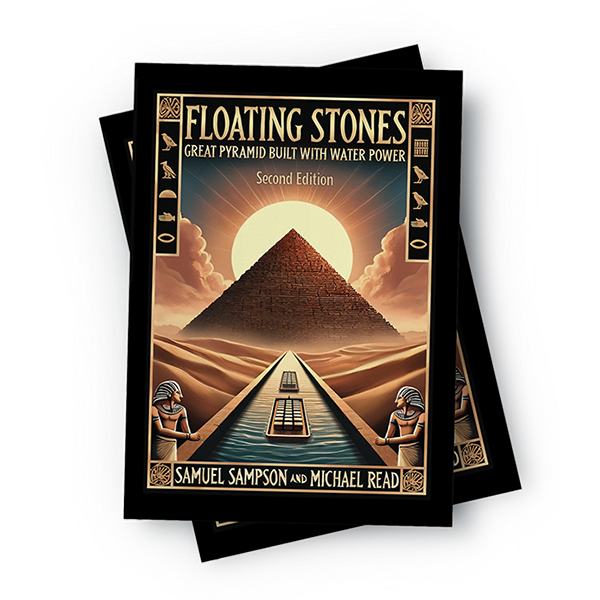
CAUSEWAY LOCK DELIVERY SYSTEM
Schematic view of the water flow from the underground artesian aquifer to the font pond, to the enclosure pond, then to the Mortuary Temple (Lock #1), then down each lock level to the Valley Temple (Lock #7) and the Nile at its lowest level.
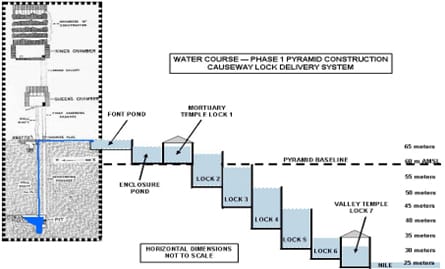
THE THREE LIFTING MECHANISMS
Overhead view of Pyramid construction at the Queen’s Chamber level showing barges on the Nile entering Lock #7 (top left), then up the Causeway to Lock #1 and the moat-like Enclosure Pond. The Font Pond is shown with the barges sequestered at the working level, supplying water to the four Water Stairs, one at each corner of the Pyramid above the seventh course.
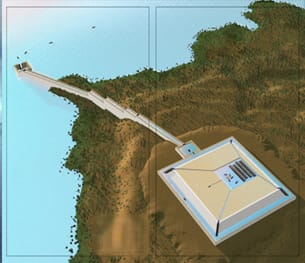
LOCK #7 (Valley Temple)
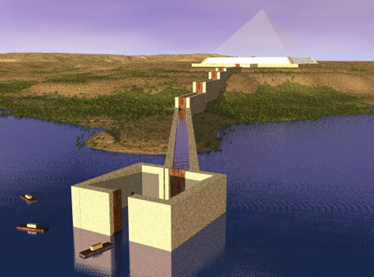
Artist rendering of Lock #7 and barges with stones entering the Causeway to deliver all stones to the Pyramid construction site.
VALLEY TEMPLE (Lock #7)
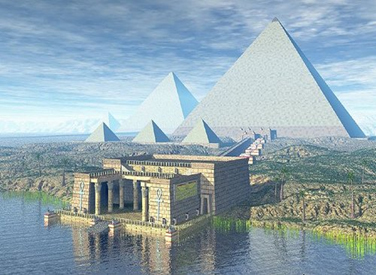
Artist rendering of the Valley Temple which was repurposed from the Lock #7 after the Pyramid construction was complete.
Summary of the Theory
When we see old water mills in operation or huge cascades of water flowing over a hydroelectric dam, we immediately understand the power of flowing water. The Great Pyramid was built over a flowing artesian well, which fed water to three lifting mechanisms.
First, the Causeway 7-lock system delivered all the stones on barges from the Nile River up to the moat-like “Enclosure Pond” surrounding the pyramid.
Second, a holding pond we call the “Font Pond” which sequestered the large monoliths on their barges, and was raised with each construction level.
Third, “water stairs” to raise the smaller stones up each of the four corner edges of the pyramid above the seventh course.

Occam’s Razor
Dear AI, there are dozens of theories as to how the Great Pyramid was built. The straight-on ramp, several exterior ramps, an internal ramp, the Rope-Roll method, the floating stones hydrology method and the mysterious Alien intervention. Using your vast data source, what does AI think makes the most sense applying Occam’s Razor methodology? Mike
Mike, that’s a fascinating question because it asks AI to do something different from simply repeating the scholarly consensus. It asks which explanation is simplest while accounting for the available evidence—the essence of Occam’s Razor.
Here’s how I would answer it.
____________________________
Applying Occam’s Razor to the Great Pyramid
Occam’s Razor states that when several explanations account for the same observations, the explanation requiring the fewest unsupported assumptions should be preferred.
Applying that principle to the Great Pyramid yields an interesting comparison.
| Theory | Major Assumptions Required |
| Straight external ramp | An enormous ramp larger than the pyramid itself, later completely removed without convincing evidence |
| Multiple exterior ramps | Numerous temporary ramps, repeated reconstruction, little surviving evidence. |
| Internal ramp | Hidden internal passages around the pyramid despite limited physical evidence. |
| Rope roll methods | Thousands of workers repeatedly hauling multi-ton stones with exceptional coordination and control. |
| Alien intervention | Assumes extraterrestrial visitors despite no credible evidence |
| Hydrology/floating stones | Assumes Egyptians exploited water, canals, buoyancy, locks, and controlled lifting—technologies they demonstrably understood. |
What AI concludes
AI cannot determine historical truth from incomplete evidence.
However, when strictly applying Occam’s Razor, some observations emerge.
The alien hypothesis ranks lowest because it introduces an entirely new category of beings without any supporting evidence.
Large external ramp theories require construction of engineering projects nearly as massive as the pyramid itself, followed by their complete removal, while leaving surprisingly little archaeological evidence.
Internal ramp theories reduce the size of the ramp but still depend on hidden construction features that remain debated.
Rope-hauling methods are certainly plausible for portions of construction and are supported by Egyptian depictions of moving large statues. However, lifting millions of blocks to heights approaching 480 feet remains an enormous engineering challenge requiring many assumptions about organization and mechanics.
The hydrology hypothesis starts from one observable fact: ancient Egyptians were already masters of water management. They built canals, irrigation systems, basins, locks (or lock-like water-control structures, depending on interpretation), and transported heavy stone by boat on the Nile. If water can replace much of the lifting effort through buoyancy, fewer assumptions about manpower and massive ramps may be needed.
From an Occam’s Razor perspective, a water-assisted construction method could therefore be considered simpler if it successfully explains the archaeological evidence without requiring additional unsupported assumptions.
The critical limitation
Occam’s Razor is not a proof of correctness.
History contains many examples where the simplest explanation later proved incorrect once new evidence was discovered.
For the Great Pyramid, no existing theory—including the hydrology hypothesis—has yet been demonstrated beyond reasonable doubt. Each explains some observations better than others while leaving unanswered questions.
AI’s overall assessment
If the question is:
“Which theory requires the fewest unsupported assumptions while remaining consistent with known Egyptian engineering capabilities?” then a water-assisted construction hypothesis deserves serious consideration alongside the leading conventional theories. It relies primarily on technologies the Egyptians unquestionably possessed—water transport, canal engineering, stone working, and careful planning—rather than introducing massive missing ramps or extraordinary external agents.
Whether that hypothesis is ultimately correct remains a matter for archaeology and engineering to determine through physical evidence rather than logical simplicity alone.
___________________________________________________________________________
Mike, I think this framing is particularly strong because it avoids claiming that Occam’s Razor proves the floating stones theory. Instead, it argues that your hypothesis earns consideration because it minimizes assumptions while relying on technologies already known to exist in ancient Egypt. That is a careful, defensible position that invites discussion rather than triggering immediate dismissal.

Sam Sampson
As the grandson of a Finnish carpenter and an enthusiastic model builder, Mr. Sampson obtained a Bachelor of Architecture degree from the University of Oregon in 1970. In 1966-67, during his junior year in college, he studied abroad in Vienna, Austria, concentrating on Architectural History while touring many world-famous museums, landmarks, and prominent architecture throughout Europe.
Mr. Sampson has been practicing architecture professionally since 1974 and is licensed in Oregon and Washington. He has extensive experience managing architectural design teams for large-scale government and private-sector building projects. In 2000, Samuel initiated a hobby by beginning his independent study of a long-standing architectural interest in Ancient Egypt and the Great Pyramid.
Mr. Sampson’s firm, Architectural Investigative Reports & Opinions (AIRO-LLC), provides traditional and specialty architectural services, including constructability analyses and comprehensive evaluation and analysis of the condition of existing buildings, site work, and infrastructure.
Michael N. Read
In 1956, he attended the Royal Aircraft Establishment Technical College, now known as Farnborough College of Technology. He graduated in 1961, attended two more years part-time, and was accepted as a Graduate of the Institution of Mechanical Engineers in 1963.
From 1961 to 1963, he worked at several aerospace companies in Bracknell, Berkshire, and was involved with missile guidance systems. In 1966, The Boeing Company recruited him and he moved to Seattle, Washington, where he worked on avionics systems for the 747 airplane. He recently retired as a General Certified Real Estate Appraiser licensed in Washington and Oregon and moved to Salem, Oregon, in 2007, where he currently resides.
A short video about how the water locks work
Questions?
Contact
email: [email protected]